5 Steps of Revenue Recognition Under ASC 606: The Complete SaaS Compliance Blueprint
G Rejitha
Table of content
When it comes to SaaS companies, following these rules is important. Incorrect SaaS revenue recognition can result in several problems. This includes inaccurate financial statements, compliance issues, audit findings, & poor business decisions.
Knowing the 5 steps of revenue recognition would be helpful for SaaS companies. These will help the companies stay compliant while maintaining accurate financial records. Whether you provide monthly subscriptions, annual contracts, or complex enterprise pricing, following the right process is always beneficial.
Revenue Recognition is Complex for SaaS Companies. Know Why?
SaaS companies are not like traditional businesses; they earn revenue over time. Customers often pay upfront for services that are delivered month after month. This, as a result, creates a gap between billing & revenue recognition.
Modern pricing models also increase complexity. Many SaaS businesses are now providing usage-based billing. In this model, customers pay according to how much they use the platform.
Additionally, growing firms are also facing challenges with several processes. This process includes contract renewals, discounts, promotional pricing, refunds, and more. Tracking all these changes manually can be very difficult. This is why many finance teams rely on revenue automation and revenue recognition software. The software can calculate revenue accurately while maintaining subscription billing compliance. Moreover, automation reduces manual work and errors. In addition to these benefits, the software also helps businesses consistently follow ASC 606.
The 5 Steps of Revenue Recognition Under ASC 606
Step 1: Identify the contract with the customer.
Everything starts with a valid contract. A contract can be anything, like a signed agreement, an online subscription, or even a digital acceptance of terms & conditions. It must clearly define the services provided, payment terms, and other important aspects.
Before recording any SaaS revenue recognition, companies must confirm that the client intends to pay. Along with this, also make sure that both parties understand the agreement.
Step 2: Identify the performance obligations
Once the contract is identified, the next step is finding out the promise given to the customers.
Performance obligations are the individual goods or services that the firm agrees to deliver. When it comes to SaaS businesses, these obligations may include:
- Software subscription
- Initial implementation
- Employee training
- Premium customer support
- Data migration
- Professional consulting
Sometimes these services are delivered together. However, sometimes, they were completely separated over different periods.
Step 3: Find the transaction price.
The next step is calculating the amount the company expects to receive from the customer. The transaction price includes the agreed contract amount while considering credits, refunds, incentives, discounts, & variable pricing.
This step becomes more challenging for companies providing a usage-based billing approach. Customer usage may vary every month; thus, finance teams must estimate or calculate variable considerations according to ASC 606 guidelines.
Identifying the transaction price accurately helps ensure proper SaaS revenue recognition. Companies making use of manual spreadsheets often face difficulty with these calculations. Thus, making revenue automation increasingly valuable.
Step 4: Allocate the transaction price to performance obligations.
After finding out the total contract value, the business must distribute that amount across each identified performance obligation. The allocation is usually based on the standalone selling price of each service.
For SaaS businesses with bundled prices, enterprise contracts or multiple service packages, allocation can be difficult. Modern revenue recognition software helps automate these calculations. At the same time, it improves accuracy & ensures subscription billing compliance.
Step 5: Recognize revenue when performance obligations are satisfied.
The final step is recognizing revenue as each service promised is delivered. This is where many businesses record revenue too early by mistake.
Receiving payment upfront does not automatically mean revenue has been earned. If the client prepays for a one-year subscription, revenue should generally be recognized every month as access to the software is provided. Until then, the remaining balance remains under deferred revenue recognition on the balance sheet.
If you’re following this final step, then it ensures accurate SaaS revenue recognition. Not only this, but it also ensures financial reporting & full compliance with ASC 606.
ASC 606 Revenue Recognition Examples for SaaS Companies
Understanding the theory behind ASC 606 is important. However, seeing how it works in real situations makes the 5 steps of revenue recognition much easier to understand.
Here are some common examples with which you can know how SaaS revenue recognition works in everyday business scenarios.
Example 1: Annual subscription paid upfront
A customer purchases a one-year subscription for $1,200 and pays the full amount on the very first day of the contract.
Though the company receives the full payment immediately, it can’t recognize the revenue at once. The software service was delivered over a year. Therefore, the revenue should be recognized at $100 each month. Until then, the remaining amount is considered deferred revenue recognition because the service has not yet been fully delivered.
Example 2: Subscription with implementation services
A SaaS firm signs a contract that consists of:
- Annual software subscription
- One-time implementation service
- Premium support
The implementation work is completed within 2 weeks, while the subscription & support continue throughout the year.
If you follow the 5 step revenue recognition model, then the implementation revenue can be recognized once the work is completed. It’s because the performance service has been delivered.
With this approach, you can ensure accurate SaaS accounting & keep financial reports compliant with ASC 606.
Example 3: Usage-based pricing
Many SaaS companies now offer usage-based billing. In this approach, customers have to pay based on transactions, storage, API calls, or active users.
Suppose a client pays a monthly platform fee plus additional charges for every API request above the included limit. The fixed subscription revenue is recognized over time. However, the variable usage charges are recognized based on the customer’s actual usage as per the contract terms.
Tracking these changing amounts manually can be a difficult process. This is why many businesses use revenue automation & revenue recognition software, as it ensures SaaS revenue recognition.
How Subscription Billing Impacts ASC 606 Compliance
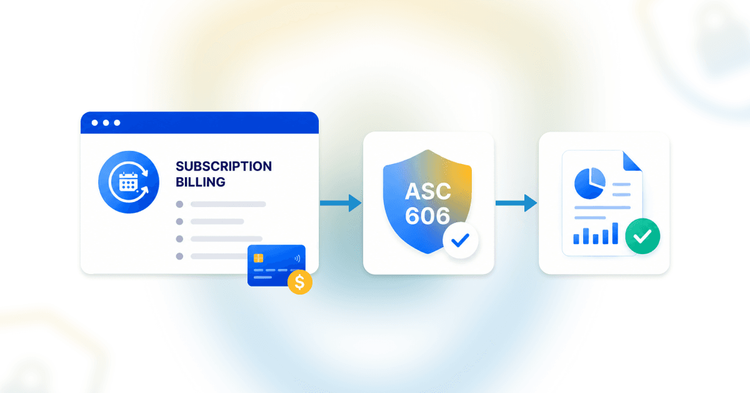
When it comes to subscription billing, it is closely connected to revenue recognition. However, they are not the same.
Subscription billing focuses on charging customers according to their contracts. Revenue recognition finds out when that billed amount can actually be recorded as earned revenue.
For example, a customer may receive an invoice for an annual subscription in January. The company collects the payment immediately, but under ASC 606, the revenue must usually be recognized over the next 12 months.
When billing systems and accounting systems are discontinued, finance teams often spend hours manually in reconciling invoices & revenue schedules. This increases the risk of errors & delays during month-end closing.
Integrating subscription billing with revenue automation helps ensure invoices, contract changes, & revenue schedules remain synchronized. Not only this, but it also improves reporting accuracy & simplifies compliance with ASC 606.
How Saaslogic Helps SaaS Companies Stay ASC 606 Compliant
Managing SaaS revenue recognition manually becomes more difficult as the businesses grow. More customers, more pricing plans, & more contract changes result in more complexity.
Saaslogic helps you streamline this process. It’s because Saaslogic is a platform that includes subscription billing, invoicing, revenue management, & financial automation. Moreover, with our platform, your finance team can automate the 5 steps of revenue recognition. At the same time, you can ensure every contract follows ASC 606 requirements.
The platform also manages subscription renewals, contract amendments, usage-based pricing & deferred revenue recognition automatically. Thus, reducing the need for manual efforts.
Moreover, it has built-in revenue automation capabilities. This helps in generating accurate revenue schedules. Thus, helping businesses maintain subscription billing compliance without depending on spreadsheets.
Conclusion
By following the 5 steps of revenue recognition, SaaS businesses will get accurate financial reporting & long-term compliance. As subscription models become more flexible & pricing structures evolve, maintaining proper SaaS revenue recognition becomes increasingly challenging.
Investing in revenue automation & reliable revenue recognition software simplified compliance. Along with this, it improves SaaS accounting & helps companies meet the requirements of ASC 606. Using the right processes & tools, SaaS businesses can focus less on accounting complexity & more on sustainable growth.

G Rejitha
Senior Technical Content Writer
G Rejitha is a Senior Technical Content Writer with over 11 years of experience creating clear, engaging, and insight-driven content for the tech industry. With a strong focus on SaaS, AI, cloud, and digital transformation. Rejitha specializes in turning complex technical concepts into easy-to-understand narratives that help businesses connect with their audience. Her work expertise includes SEO-driven web contents, blogs, whitepapers, case studies, product documentation, newsletters, and more. Rejitha delivers content that supports brand credibility, drives engagement, and simplifies technology for decision-makers, product teams, and customers alike.
Related Topics
- When Should a SaaS Startup Move Away from Stripe-Only Billing? Tue Sep 01 2026
- What Is Billing Orchestration? A Guide for Modern SaaS Companies Tue Jul 28 2026
- What is Revenue Automation? A Complete Guide for SaaS Businesses Fri Jul 03 2026
- Tiered Pricing Model in SaaS: How It Benefits Your Subscription Business Wed Apr 29 2026
- Revenue Leakage in SaaS: 7 Hidden Places Your Saas is Losing ARR Without Knowing It Thu Apr 16 2026
Categories
- Churn Reduction and Customer Retention
- Pricing Strategies and Revenue Models
- Billing, Payments and Invoicing
- Customization and Enterprise Use Cases
- Growth Scale and Business Strategy
- Subscription Management and Optimization
- Technology and Integrations
- Startups and Marketing
- Trends and Thought Leadership
- SaaS Accounting & Compliance
- Revenue automation
Frequently Asked Questions
Yes. Modern billing platforms with revenue automation & revenue recognition software can automatically perform several processes. This includes calculating revenue schedules, managing contract changes, tracking deferred revenue recognition & supporting ASC 606.