Tiered Pricing Model in SaaS: How It Benefits Your Subscription Business
G Rejitha
Table of content
- What is Tiered Pricing in SaaS?
- Why is Tiered Pricing the Best Pricing Model for SaaS?
- How a Tiered Pricing Model Works in a Subscription Business
- Tiered vs. Usage-Based Pricing: Which is Better?
- Benefits of Tiered Pricing Strategy for SaaS Businesses
- Steps to Build an Effective Tiered Pricing Strategy
- Common Mistakes to Avoid in Tiered Pricing in SaaS
- Tiered Pricing in AI SaaS: What’s Changing?
- Why Saaslogic is Ideal for Tiered Pricing Management
- Why a Tiered Pricing Model is Essential for SaaS Growth
What is Tiered Pricing in SaaS?
Tiered pricing is all about giving customers a choice. Rather than locking everyone into the same plan, SaaS companies offer multiple options. Each option has its own features, usage limits, or level of service. You can simply choose the one that matches your requirements.
A typical setup might look something like this:
- Basic Plan: A great starting point for small teams who want core functionality without spending too much.
- Pro Plan: Built for growing businesses that need more advanced tools to keep up with demand.
- Enterprise Plan: The full experience with custom features & dedicated support for larger teams.
This tiered pricing model helps SaaS companies to fulfil the different customer segments without forcing a one-size-fits-all approach.
Why is Tiered Pricing the Best Pricing Model for SaaS?
Choosing the best pricing model for SaaS depends on your product & audience. However, tiered pricing often stands out. This is because it balances flexibility & predictability.
Key Advantages:
Suitable for Multiple Customer Segments
From startups to enterprises, tiered pricing ensures that every customer finds a plan as per their business needs.
Encourages Upselling
As customers grow, they naturally move to higher tiers. Thus, increasing your revenue without extra acquisition costs.
Predictable Revenue Growth
Unlike purely usage-based models, tiered pricing provides stable & recurring revenue streams.
Simplifies Decision-Making
Clear pricing tiers make it easier for customers to compare plans and choose quickly.
How a Tiered Pricing Model Works in a Subscription Business
In a subscription business, the tiered pricing model is designed in such a way that it aligns value with pricing.
Each tier typically differs in features, usage limits (API calls, users, storage, etc.), support levels, & customization options.
For example:
- Entry-level users get essential features at a lower price.
- Mid-tier users get improved capabilities.
- High-tier users get premium features and dedicated support.
If you have a right subscription billing software like Saaslogic, then your businesses can automate tier management, billing cycles & upgrades seamlessly.
Tiered vs. Usage-Based Pricing: Which is Better?
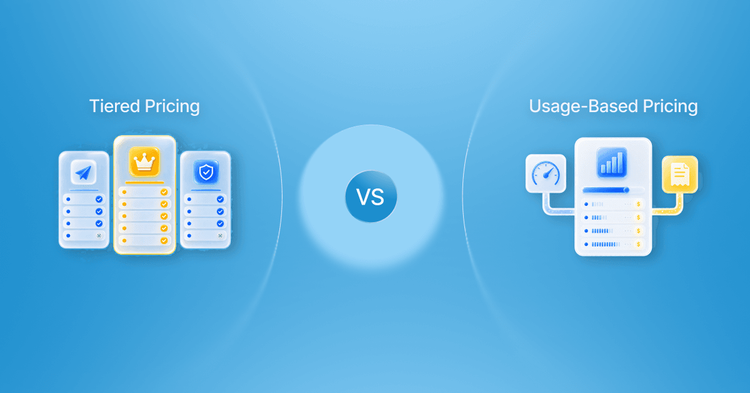
Tiered vs. usage-based pricing is a common debate in SaaS. Both models have their strengths, and as a result, many companies now use a hybrid approach.
Tiered pricing includes fizzed pricing plan, predictable revenue, &easier for customers to understand.
Usage-based pricing includes pay-as-you-go model, flexible but less predictable revenue, & ideal for highly variable usage products.
Hybrid Model (Best of Both Worlds):
- Many modern SaaS companies combine both:
- Base subscription (tiered pricing).
- Additional charges based on usage.
This is effective mainly for AI products. Thus, making it a powerful AI SaaS pricing strategy.
Benefits of Tiered Pricing Strategy for SaaS Businesses
A well-designed tiered pricing strategy can transform your SaaS business in several ways.
Improved Customer Retention
Customers are less likely to leave when they have flexible pricing options. Instead of leaving, they can downgrade to a lower tier. This directly supports better customer retention & reduces revenue loss.
Better Churn Management
Effective churn management becomes easier with a tiered pricing approach. It’s because this approach provides downgrade options rather than cancellations. Not only this, but it also provides upgrade incentives & custom features based on user behavior.
With platforms like Saaslogic, you can track churn signals & automate uretention strategies.
Higher Lifetime Value (LTV)
Tiered pricing helps you to start with low entry barriers & gradually increase customer spend. This leads to higher lifetime value as customers scale within your ecosystem.
Clear Value Communication
Each tier communicates value clearly on what users get & why they should upgrade. Transparency builds trust & improves conversions.
Scalability for Growing SaaS Companies
As your product evolves, you can add new tiers, adjust pricing, & introduce feature bundles. This flexibility makes tiered pricing ideal for fast-growing SaaS companies.
Steps to Build an Effective Tiered Pricing Strategy
Creating a successful tiered pricing model requires careful planning.
Here’s a simple “how-to" guide:
Step 1: Know Your Customer Segments
- Identify different user groups (startups, SMBs, enterprises).
- Analyze their needs, budgets, & usage patterns.
Step 2: Define Value Metrics
Choose what you charge for the number of users, API calls, storage & features. This is important for both SaaS pricing strategy and scalability.
Step 3: Create Clear Tier Differentiation
Each tier should have diverse features, a clear upgrade value, & logical pricing progression. Moreover, avoid overlapping features that confuse users.
Step 4: Price Strategically
- Entry tier should be affordable.
- Mid-tier should deliver the most value.
- High tier should justify premium pricing.
Step 5: Use Data to Optimize
Track conversion rates, upgrade/downgrade patterns, & churn rates. With SaaS subscription management tools like Saaslogic, you can continuously refine your pricing.
Step 6: Automate Billing and Management
A reliable subscription billing software ensures accurate invoicing, smooth upgrades/downgrades & real-time analytics. This is necessary for managing complex subscription pricing models.
Common Mistakes to Avoid in Tiered Pricing in SaaS
Tiered pricing is powerful, but at the same time, mistakes can reduce its effectiveness. Here are some common mistakes that you should avoid in this pricing model.
Too Many Pricing Tiers
Too many options can overwhelm customers. Thus, sticking to 3 - 4 tiers would be beneficial.
Poor Feature Distribution
If all valuable features are locked in the highest tier, then lower tiers become unattractive.
Ignoring Customer Feedback
Do not avoid customer feedback. In fact, your pricing should evolve based on user behaviors & feedback.
Lack of Flexibility
Rigid pricing models can result in customer loss. Thus, allow easy upgrades & downgrades.
Tiered Pricing in AI SaaS: What’s Changing?
Pricing models are updating quickly with the rise of AI products.
Here are some key trends in AI SaaS pricing strategy:
- Combining tiered & usage-based pricing.
- Charging based on outcomes (e.g., processed data, generated content).
- Flexible pricing for APIs & token usage.
When it comes to AI companies, a hybrid tiered pricing strategy supported by modern SaaS billing systems like Saaslogic is becoming essential.
Why Saaslogic is Ideal for Tiered Pricing Management
Managing a tiered pricing model manually can be difficult. This is where Saaslogic comes in.
Saaslogic helps SaaS businesses to:
- Automate tier-based billing.
- Manage multiple pricing plans.
- Track revenue and customer behavior.
- Reduce churn with smart insights.
- Support hybrid models (tiered + usage-based).
Conclusion: Why a Tiered Pricing Model is Essential for SaaS Growth
Tiered pricing is more than just a way to structure your rates. It's genuinely one of the smarter moves a growing business can make. When done right, it allows customers to choose the models suitable for your requirements. Thus, keeps them around longer, and makes it a whole lot easier to spot and reduce churn before it becomes a real problem.
Whether you're just getting a new product off the ground or trying to get more out of an existing subscription model, the right tiered strategy can be quite beneficial for you. Pair that with the right billing tools & save your precious time. Not only this, but you’re also actively creating a smoother experience for your users. At the same time, you’re opening doors to revenue that you might otherwise have missed.

G Rejitha
Senior Technical Content Writer
G Rejitha is a Senior Technical Content Writer with over 11 years of experience creating clear, engaging, and insight-driven content for the tech industry. With a strong focus on SaaS, AI, cloud, and digital transformation. Rejitha specializes in turning complex technical concepts into easy-to-understand narratives that help businesses connect with their audience. Her work expertise includes SEO-driven web contents, blogs, whitepapers, case studies, product documentation, newsletters, and more. Rejitha delivers content that supports brand credibility, drives engagement, and simplifies technology for decision-makers, product teams, and customers alike.
Related Topics
- When Should a SaaS Startup Move Away from Stripe-Only Billing? Tue Sep 01 2026
- What Is Billing Orchestration? A Guide for Modern SaaS Companies Tue Jul 28 2026
- What is Revenue Automation? A Complete Guide for SaaS Businesses Fri Jul 03 2026
- 5 Steps of Revenue Recognition Under ASC 606: The Complete SaaS Compliance Blueprint Tue Jun 23 2026
- Tiered Pricing Model in SaaS: How It Benefits Your Subscription Business Wed Apr 29 2026
Categories
- Churn Reduction and Customer Retention
- Pricing Strategies and Revenue Models
- Billing, Payments and Invoicing
- Customization and Enterprise Use Cases
- Growth Scale and Business Strategy
- Subscription Management and Optimization
- Technology and Integrations
- Startups and Marketing
- Trends and Thought Leadership
- SaaS Accounting & Compliance
- Revenue automation
Frequently Asked Questions
Tiered pricing in SaaS is a subscription pricing model with multiple plans offering different features and pricing.
