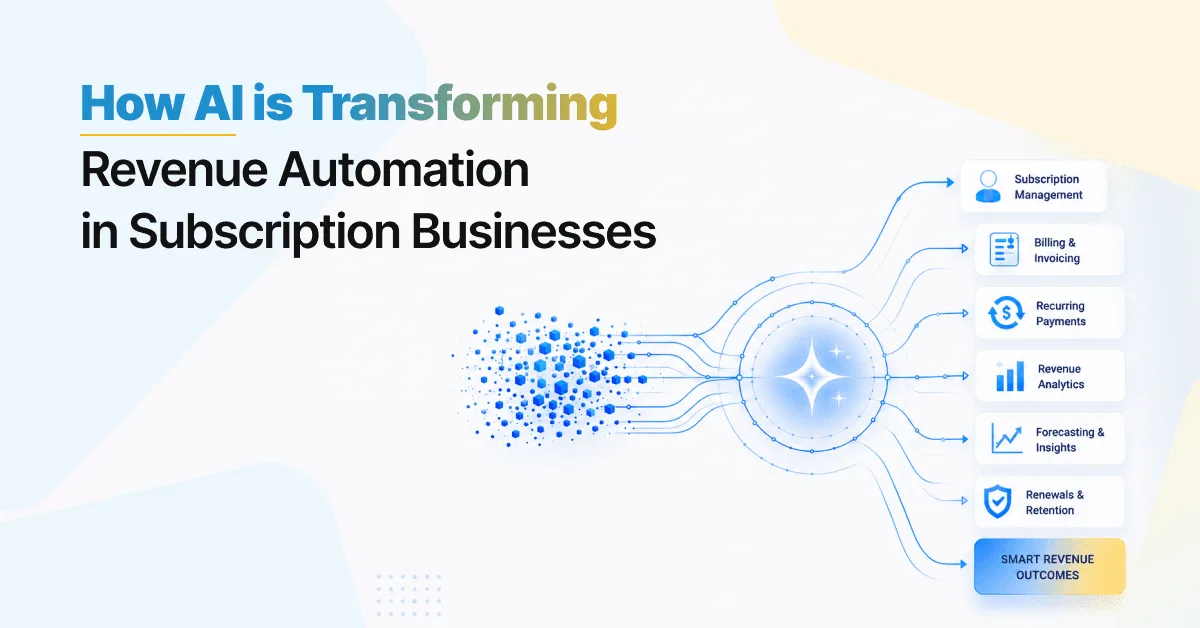
How AI Is Transforming Revenue Automation in Subscription Businesses
G Rejitha
Table of content
What Benefits Does AI Bring to Revenue Automation?
Traditional revenue automation already handles a lot of processes. It generates invoices, records payments, recognizes revenue on schedule, and keeps subscription lifecycles moving without someone manually doing every step. What it doesn’t do is think. It follows the rules it was given, nothing more.
Revenue recognition software can tell you a payment failed. It can't tell you why failed payments have tripled among annual-plan customers this quarter. That's the layer AI adds. Rather than just executing instructions, AI works through the data itself. AI identifies patterns, flags anomalies, and makes reasonable predictions.
For a subscription business, that means the finance team doesn’t have to sit and spend hours looking for the one invoice that’s wrong. AI is already watching subscription activity, payment behavior, and contract changes, and it says something when the pattern breaks.
AI's more useful contribution is that it doesn't stop at financial data. It analyzes customer behavior, usage trends, and history together, so instead of a report showing what happened last month, you get a reasonable read on what’s about to happen next month. As your subscription business grows, future-focused insights become more valuable than previous reports.
AI Revenue Automation vs. Automated Revenue Recognition
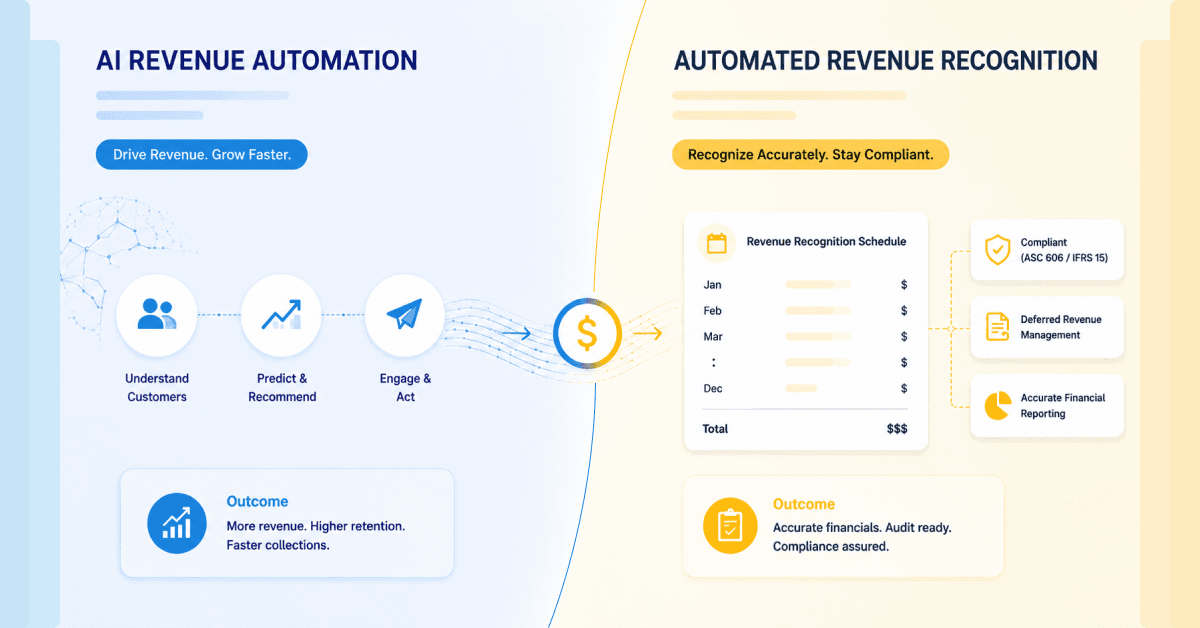
People use these two terms interchangeably, and that’s a mistake: they solve different problems.
Automated revenue recognition ensures revenue is recorded correctly and stays compliant. AI revenue automation goes a step further by helping businesses manage, predict, and optimize revenue more effectively.
| AI Revenue Automation | Automated Revenue Recognition |
|---|---|
| Uses AI to improve financial decision-making | Records revenue automatically based on accounting rules |
| Forecasts where revenue is headed | Records revenue accurately once it’s earned |
| Catches billing errors and revenue leakage | Keeps the books compliant with accounting standards |
| Powers churn prediction and subscription analytics | Focuses on recognition schedules |
| Drives revenue optimization across finance | Automates the calculations behind the numbers |
Where AI Is Making the Biggest Difference
Billing that catches its own mistakes
Subscription billing has become more complex with multiple pricing models, upgrades, downgrades, and discounts. AI simplifies revenue automation by checking invoices before they're sent and flagging billing errors like incorrect prorations, expired discounts, or missed plan updates. Instead of reviewing every invoice manually, finance teams focus only on flagged issues - which reduces errors and improves customer trust.
Forecasts that stay relevant after they're created
Traditional spreadsheet forecasting relies on past data and quickly becomes outdated as customer behavior changes. AI improves revenue forecasting by analyzing renewals, payment trends, customer growth, and usage data. As new data comes in, forecasts update automatically, helping finance teams make more accurate and timely decisions.
Spotting churn before the cancellation email
Customer retention is critical for subscription businesses, but early signs of churn are often easy to miss. AI monitors customer usage, logins, payments, and support activity to identify churn risks before a customer cancels. This helps teams take timely action, improve retention, and protect recurring revenue.
Finding the revenue that's quietly slipping away
Revenue leakage often comes from small billing issues like missed renewals, failed payments, or unbilled usage. AI continuously monitors billing, contracts, and payment data to detect these errors early. By fixing issues before they grow, businesses can reduce revenue leakage, recover lost billing, and secure recurring revenue.
What Businesses Actually Get Out of AI
Fewer errors
AI checks invoices, subscription records, payments, pricing, and contract changes before they reach your financial reports. That means finance teams catch issues early instead of discovering them during the financial close, when fixes are more time-consuming and expensive.
Faster financial operations
AI automates repetitive tasks like invoice validation, reconciliations, and payment matching. This reduces manual effort and helps finance teams finish their tasks more efficiently.
Enhanced decision making
AI also improves decision-making with predictive insights. By analyzing historical revenue, customer behavior, payment trends, and renewal patterns, businesses can forecast revenue more accurately, identify churn risks, and make smarter financial decisions.
Revenue optimization
AI helps optimize revenue. It can identify underperforming pricing plans, revenue leakage, weak renewal processes, and high-value customer segments that might otherwise go unnoticed. This creates opportunities to increase revenue and improve retention.
Scales with business growth
As subscription businesses grow, AI scales with them. It handles increasing transaction volumes without adding more manual work, while continuously monitoring financial data to detect unusual activity before small issues become costly problems.
Supports finance teams
AI supports finance teams rather than replacing them. By taking over repetitive tasks, it gives finance professionals more time to focus on analysis, strategy, and decisions that drive business growth.
How Saaslogic Approaches This
At Saaslogic, we don't think revenue automation should just handle repetitive finance work. It should help subscription businesses make faster, smarter financial calls.
Our platform brings billing, invoicing, revenue recognition, and reporting into one system instead of five disconnected tools.
As AI keeps advancing, we're staying focused on what actually helps: better forecasting, less revenue leakage, sharper subscription analytics, and financial processes that stay simple even as the business grows more complex.
We're not handing finance teams a black box and asking them to trust it. We're keeping them in control, backed by sharper insight - insight that supports better planning, stronger compliance, and revenue growth that actually lasts.
Subscription finance isn't just about automating tasks anymore. It's about making every financial decision better informed, and that's what intelligent revenue automation is really for.
Conclusion
Subscription businesses are scaling fast, and the financial complexity is scaling right along with them. Manual billing, renewals, and forecasting just don't hold up anymore. AI-powered revenue automation changes that: sharper decisions, less revenue leakage, better forecasting, and real visibility into where the money's actually going.
Whether you're a startup or an established SaaS company, building this now means a financial foundation that still holds up later.

G Rejitha
Senior Technical Content Writer
G Rejitha is a Senior Technical Content Writer with over 11 years of experience creating clear, engaging, and insight-driven content for the tech industry. With a strong focus on SaaS, AI, cloud, and digital transformation. Rejitha specializes in turning complex technical concepts into easy-to-understand narratives that help businesses connect with their audience. Her work expertise includes SEO-driven web contents, blogs, whitepapers, case studies, product documentation, newsletters, and more. Rejitha delivers content that supports brand credibility, drives engagement, and simplifies technology for decision-makers, product teams, and customers alike.
Categories
- Churn Reduction and Customer Retention
- Pricing Strategies and Revenue Models
- Billing, Payments and Invoicing
- Customization and Enterprise Use Cases
- Growth Scale and Business Strategy
- Subscription Management and Optimization
- Technology and Integrations
- Startups and Marketing
- Trends and Thought Leadership
- SaaS Accounting & Compliance
- Revenue automation
Frequently Asked Questions
It’s the use of artificial intelligence to strengthen subscription finance - billing, revenue recognition, forecasting, payment monitoring, subscription analytics, and reporting. Unlike traditional automation, it also predicts trends, catches revenue leakage, and offers recommendations that actually help with financial decisions.