What Is Billing Orchestration? A Guide for Modern SaaS Companies
G Rejitha
Table of content
- Why It Matters: The Problem Billing Orchestration Solves
- How Billing Orchestration Works
- Billing Orchestration vs. Payment Orchestration
- Billing Orchestration vs. Subscription Management
- Benefits of Billing Orchestration for SaaS Companies
- What to Look for in a Billing Orchestration Platform
- Signs Your SaaS Needs Billing Orchestration
- Frequently Asked Questions
Running a SaaS business means dealing with billing that can quickly become complicated. Customers may be on monthly, annual, or usage-based plans, each with different payment methods, tax rules, and currencies. Managing all of these tasks manually takes time and increases the risk of errors.
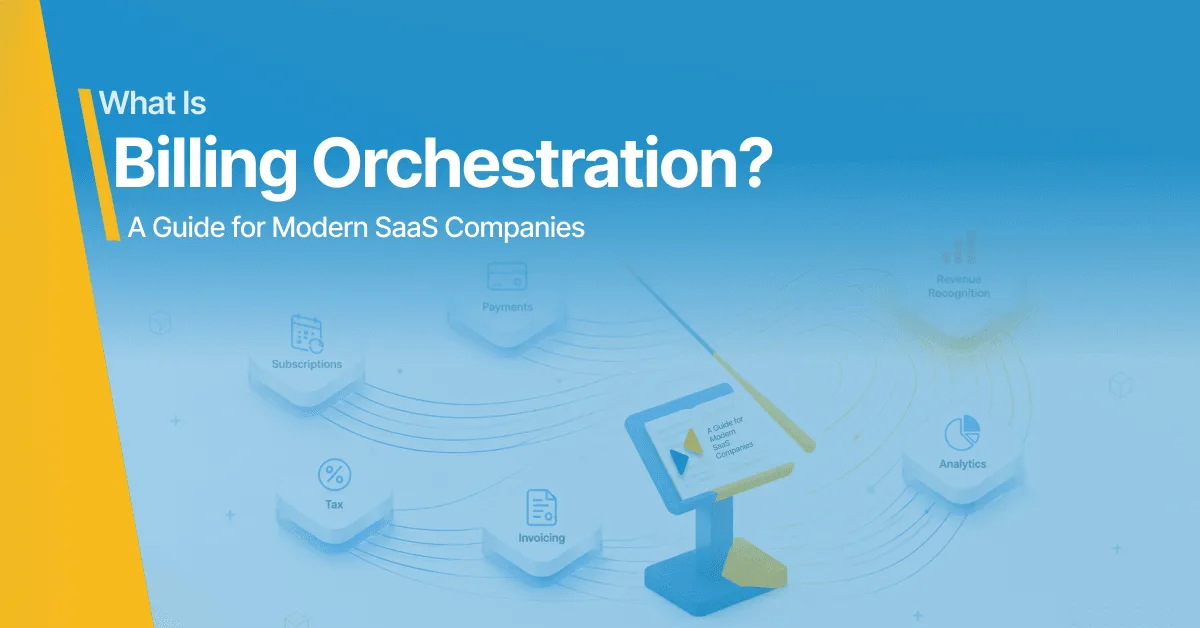
Billing orchestration brings every part of your billing process together in one automated system. It connects subscriptions, invoicing, payments, taxes, and payment recovery, helping everything work smoothly. Instead of using separate tools and manual tasks, your team can manage billing more efficiently and focus on growing the business.
Why It Matters: The Problem Billing Orchestration Solves
Most SaaS companies start simple: one product, one pricing plan, and one payment gateway. But as the business grows, so does the complexity. New pricing tiers are introduced, usage-based billing becomes a requirement for enterprise customers, and regional payment methods need to be supported.
Without billing orchestration:
- Failed payments go unnoticed.
- Customers are billed incorrectly after plan changes.
- Invoices are sent late.
- Finance teams spend hours reconciling data manually.
These aren't small annoyances. They directly affect revenue. A failed payment that isn't retried properly is lost money, & a wrong invoice affects customer trust. A slow dunning process (the follow-up sent to customers after a failed payment) means real revenue leakage every single month.
Billing orchestration solves the problem by automating the entire chain of events, from the moment a customer signs up to the moment their invoice is paid. It removes the manual patchwork and replaces it with a system that runs on its own, correctly, every time.
How Billing Orchestration Works
At its core, billing orchestration connects several moving parts into one coordinated flow. When a customer upgrades a plan, adds seats, or exceeds their usage limit, the billing system automatically updates the invoice, applies proration and taxes, and processes the payment through the right gateway.
Here is what typically happens behind the scenes with a subscription billing orchestration setup:
- Collect customer and usage data from your product, CRM, or metering system.
- Match the data to the customer's pricing plan to calculate the accurate charges.
- Generate invoices automatically with the right currency, taxes, discounts, and any prorated charges.
- Process payments through the appropriate gateway. If a payment fails, automated retries and reminder emails help recover it without manual effort.
- Sync revenue data with your accounting and analytics tools so your finance team always has accurate, up-to-date financial records.
This is what billing automation for SaaS should look like. Instead of using different tools, orchestration makes them act as one system with one shared source of truth.
Billing Orchestration vs. Payment Orchestration
Billing orchestration and payment orchestration are closely related but serve different purposes. Billing orchestration manages the complete billing process, including pricing, subscriptions, invoicing, taxes, renewals, and revenue reporting. It ensures customers are billed accurately throughout their subscription lifecycle.
Payment orchestration focuses only on collecting payments. It connects multiple payment gateways, routes transactions, and helps recover failed payments.
For SaaS businesses, payment orchestration is just one part of billing orchestration. A billing orchestration platform combines billing, payments, and financial operations into a single workflow, reducing manual effort, improving accuracy, and supporting recurring revenue growth.
Billing Orchestration vs. Subscription Management

This is another common point of confusion. Subscription management is about handling the lifecycle of a customer's plan, including upgrades, downgrades, pauses, trials, and cancellations. It answers the question, “What plan is this customer on, and how does it change over time?”
Billing orchestration is broader. It takes what subscription management decides and turns it into action, generating the invoice, collecting the payment, applying tax rules, and recovering failed charges.
In simple terms, subscription management defines what a customer should be billed for, while billing orchestration ensures every charge is billed accurately, on time, and through the right payment method.
Benefits of Billing Orchestration for SaaS Companies
The biggest benefit of billing orchestration is that it saves time. Finance and engineering teams no longer need to build custom code every time a new pricing model is introduced. This can save weeks of engineering work.
Beyond time, this approach secures revenue. Automated dunning helps recover failed payments that might otherwise be lost. Accurate invoicing and smooth payment workflows help reduce billing disputes, leading to fewer support requests and a better customer experience.
It also makes it possible to support complex pricing without chaos. Usage-based billing is the approach where customers pay based on usage, such as API calls, storage, or seats, which is difficult to manage manually. The orchestration layer handles the calculations automatically, making it easier to launch usage-based pricing while keeping invoices accurate.
Finally, it gives your finance team clean, reliable data. Instead of pulling data from multiple tools, one connected system manages invoices, payments, refunds, and revenue records.
What to Look for in a Billing Orchestration Platform
When evaluating a billing orchestration solution, focus on a few things that actually matter.
- Check how well it supports the pricing models you use today and the ones you might use in the future: flat fee, tiered, usage-based, or hybrid.
- Pay close attention to its dunning management features, as they help recover failed payments and reduce revenue loss.
- Ensure it connects easily with your existing payment gateways, accounting software, and CRM.
- If you sell internationally, make sure the platform can handle tax compliance across different regions.
- Choose a platform with clear reporting, so every invoice and payment is easy to track.
Signs Your SaaS Needs Billing Orchestration
If your team is manually updating invoices every time a customer changes their plan, it's a clear sign. If your team is still following up on failed payments instead of relying on automated recovery, you're losing valuable revenue. If launching a new pricing plan takes weeks of engineering work instead of a simple configuration change, billing orchestration can simplify the process.
There are several other signs include billing errors that lead to customer complaints. Finance teams are spending more time reconciling data than reviewing it or they have plans to introduce usage-based pricing without a system that can calculate charges accurately. If any of these sounds familiar, it's time to consider billing orchestration.
Wrapping it up
Getting billing right isn't about adding more tools; it's about making the ones you have work together. That's the real value of billing orchestration: fewer manual fixes, faster invoicing, and revenue that doesn't quietly slip through the cracks.
If you're tired of managing spreadsheets and disconnected systems, platforms like Saaslogic would be beneficial for you. It brings your entire billing process into one place, so your team can spend less time managing payments and more time growing the business.

G Rejitha
Senior Technical Content Writer
G Rejitha is a Senior Technical Content Writer with over 11 years of experience creating clear, engaging, and insight-driven content for the tech industry. With a strong focus on SaaS, AI, cloud, and digital transformation. Rejitha specializes in turning complex technical concepts into easy-to-understand narratives that help businesses connect with their audience. Her work expertise includes SEO-driven web contents, blogs, whitepapers, case studies, product documentation, newsletters, and more. Rejitha delivers content that supports brand credibility, drives engagement, and simplifies technology for decision-makers, product teams, and customers alike.
Related Topics
- When Should a SaaS Startup Move Away from Stripe-Only Billing? Tue Sep 01 2026
- What Is Billing Orchestration? A Guide for Modern SaaS Companies Tue Jul 28 2026
- What is Revenue Automation? A Complete Guide for SaaS Businesses Fri Jul 03 2026
- 5 Steps of Revenue Recognition Under ASC 606: The Complete SaaS Compliance Blueprint Tue Jun 23 2026
- Tiered Pricing Model in SaaS: How It Benefits Your Subscription Business Wed Apr 29 2026
Categories
- Churn Reduction and Customer Retention
- Pricing Strategies and Revenue Models
- Billing, Payments and Invoicing
- Customization and Enterprise Use Cases
- Growth Scale and Business Strategy
- Subscription Management and Optimization
- Technology and Integrations
- Startups and Marketing
- Trends and Thought Leadership
- SaaS Accounting & Compliance
- Revenue automation
Frequently Asked Questions
Billing orchestration in SaaS is the process of automating and connecting every part of the billing system, invoicing, payments, taxes, and subscription changes. This ensures that all components function together as a seamless workflow rather than as separate manual tasks.