The Rise of Autonomous Billing: Why AI-Native Platforms Will Replace Legacy Engines in 2026
G Rejitha
Table of content
Today, billing isn’t just an administrative task in the SaaS world. It’s a strategic growth engine. However, many companies still rely on traditional billing systems. These systems are slow, rigid, and expensive to maintain. The traditional approaches are struggling to keep up with new pricing models like usage-based billing and hybrid billing. Thus, a shift is crucial.
Here comes the role of autonomous billing.
It’s a new era where AI-native billing platforms automate almost every aspect of the billing lifecycle. This ranges from metering and invoicing to compliance and churn prediction. Autonomous billing is not just an upgrade; it’s essential for SaaS businesses to scale profitably and sustainably.
What is Autonomous Billing?
Autonomous billing refers to the billing systems that function with minimal human effort. It works with advanced AI and machine learning. Autonomous billing systems understand contracts, adapt to pricing changes, & execute the billing process automatically. In addition to these functions, the system also interprets pricing logic and real-time usage events to ensure accurate billing outcomes without requiring constant human effort.
An AI-native billing platform built from scratch with AI at its core makes it capable of self-optimization and decision-making. This is not just an automated billing software that makes the invoicing process faster. Instead, it’s a smarter system that transforms billing from a cost center into a strategic engine for growth.
How Autonomous Billing Works
Traditional billing systems rely on manual configuration. Every pricing change, discount, or contract update often needs engineering work or complex processes. With autonomous billing systems, you can avoid this dependency by:
- Interpreting contracts automatically: AI reads and understands pricing terms, billing frequencies, & conditions without manual effort.
- Adapting to pricing changes in real time: Whether it’s usage-based billing, tiered pricing, or hybrid models, the systems adjust dynamically.
- Processing real-time usage events: Usage is tracked and billed in real time, and not later.
- Executing billing workflows autonomously: Invoicing, proration, renewals, upgrades, downgrades, and adjustments happen without human intervention.
With this, finance and product teams can move faster without worrying about billing errors and system limitations.
Limitations of Legacy Billing Systems
Traditional billing systems often struggle to adapt to modern business models. Some limitations of these systems are:
Manual Complexity and Scalability Issues
Traditional systems are often rigid and difficult to modify. They need extensive rule-writing and technical effort to support new pricing models.
For example:
- They cannot manage dynamic usage-based billing without manual setup for each metric or customer tier.
- Complex contracts with hybrid pricing, promotions, and variable overages need manual coding.
This leads to finance and engineering teams spending weeks configuring changes.
Disconnected Data and Systems
Legacy systems often function separately with billing, CRM, revenue management, and analytics in different platforms.
This leads to:
- Inaccurate or late revenue reporting.
- Errors in revenue recognition.
- Delayed insights into customer health.
When your data isn’t connected, then billing becomes reactive instead of helping you grow.
Limited Intelligence
Most traditional platforms work on certain rules. They don’t learn from data, are unable to proactively detect anomalies, and often lack predictive capabilities to support strategic decisions. This includes churn mitigation or pricing optimization.
SaaS businesses adopt smarter monetization; these barriers prevent scaling smoothly.
Why SaaS Billing Is Evolving
New market trends, financial challenges, & customer expectations are making smarter billing essential.
Growth of Usage-Based Pricing
Usage-based pricing, where customers pay for what they use is common now. Key parameters such as API calls, data consumption, or compute minutes can be integrated into pricing models. It’s because they align cost with the value delivered.
The usage-based pricing model is effective because it can:
- Help customers sign up without hassles.
- Reduce the difficulty in joining.
- Increase long-term monetization through expansion revenue.
However, implementing usage-based billing manually can cause problems in accuracy, data processing, and customer trust.
Demand for Real-Time Insights and Forecasting
Nowadays, businesses need not just invoices; they need actionable insights in real time. Legacy systems tend to close the books days or weeks after a particular billing period. Thus, delaying access into:
- MRR (Monthly Recurring Revenue) trends
- ARR forecasts
- Churn rate dynamics
Modern businesses rely on billing data to make pricing and product decisions fast.
Increasing Customer Expectations
Subscriptions are growing and thus, customers expect clear, fair, & flexible billing. Customers always want clear and accurate invoices. Confusing bills leads to frustration and churn.
Key Advantages of AI-Native Billing Platforms
Autonomous billing platforms make use of AI in ways that traditional systems can’t match.
Automated Contract Interpretation
AI can read contracts and auto-configure billing logic. This reduces the time from signing a contract to sending the first bill & reduces manual errors.
Real-Time Usage Metering and Rating
Instead of processing usage later, the autonomous platform tracks it in real time for accurate billing and timely alerts.
Intelligent Revenue Recognition and Compliance
With built-in revenue recognition rules like ASC 606/IFRS 15, AI-native platforms manage compliance automatically. Along with this, it also ensures accurate audit-ready financials.
Predictive Insights and Risk Mitigation
AI tools can find:
- Customers who may cancel the subscription soon
- Unusual usage patterns
- Pricing inefficiencies
Seamless Integration with Existing Infrastructure
Advanced autonomous billing platforms connect with CRM, payment gateways, ERP, revenue systems, and analytical tools smoothly. Thus, supporting a unified view of the customer lifecycle.
Autonomous Billing and Usage-Based Models
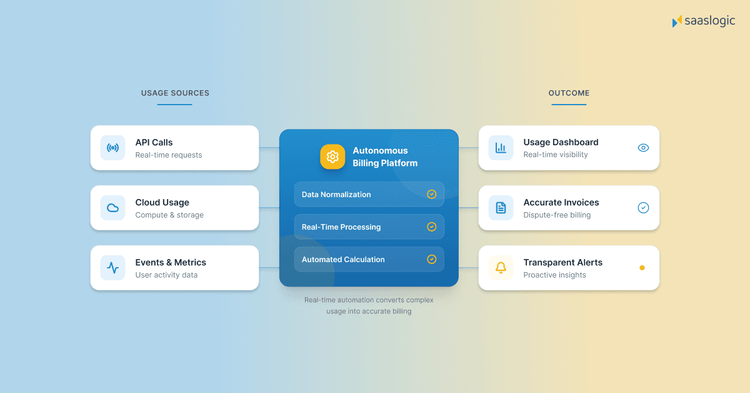
The usage-based model is one of the major challenges for billing systems and legacy tools facing difficulty to support it.
Why Is Usage Billing Important?
It shows the real value of delivery and provides flexibility to customers. Salesforce usage tiers, cloud consumption metrics, and API-linked pricing are now common in SaaS because they match what customers pay with the value they receive, help increase usage, and boost revenue growth without requiring everyone to use the same subscription plan.
The Technical Complexity
Tracking usage is more than counting units. It means:
- Managing high-velocity event streams.
- Normalizing data from multiple sources.
- Ensuring accuracy and reliability.
- Avoiding “bill shock” through alerts.
Traditional systems lack the scalability and real-time capacities required for sophisticated usage billing.
Autonomous platforms track usage, calculate charges, and create invoices automatically in real time. They also provide dashboards that make charges transparent to customers, reducing billing disputes and churn.
Impact on Churn, Customer Experience, and Growth
Billing is not just a finance option; it plays a key role in customer experience. Here’s how autonomous billing helps:
Reducing Churn Rate
Clear and accurate bills reduce frustration. When customers trust the invoice, the chances of renewal and expanded services are high. Autonomous systems identify warning signs like late payments and respond before customers' churn.
Increasing Transparency and Trust
Real-time dashboards, usage alerts, and clear bills keep customers informed and avoid disputes.
Enabling Strategic Growth
Shifting the billing process from manual tasks to automated workflows can be useful for SaaS teams. With this, the team can focus on:
- Product innovation
- Pricing strategy
- Expansion into new markets
Instead of manually configuring billing rules and solving problems, finance teams can become strategic partners in growth.
Looking Ahead: Pricing Based on Value
Billing is no longer a back-office process; it’s an essential factor. In 2026 and beyond, autonomous billing powered by AI-native platforms will replace legacy engines. It’s because:
- They manage the latest modernization models, like usage-based billing, effortlessly.
- They provide accurate, real-time billing & revenue recognition.
- They improve the customer experience and reduce churn.
- They automate compliance, insights, and forecasting.
As SaaS businesses evolve, billing should also evolve. If you want to scale with confidence, then make use of autonomous billing and AI-native platforms.
G Rejitha
Senior Technical Content Writer
G Rejitha is a Senior Technical Content Writer with over 11 years of experience creating clear, engaging, and insight-driven content for the tech industry. With a strong focus on SaaS, AI, cloud, and digital transformation. Rejitha specializes in turning complex technical concepts into easy-to-understand narratives that help businesses connect with their audience. Her work expertise includes SEO-driven web contents, blogs, whitepapers, case studies, product documentation, newsletters, and more. Rejitha delivers content that supports brand credibility, drives engagement, and simplifies technology for decision-makers, product teams, and customers alike.
Related Topics
- When Should a SaaS Startup Move Away from Stripe-Only Billing? Tue Sep 01 2026
- What Is Billing Orchestration? A Guide for Modern SaaS Companies Tue Jul 28 2026
- What is Revenue Automation? A Complete Guide for SaaS Businesses Fri Jul 03 2026
- 5 Steps of Revenue Recognition Under ASC 606: The Complete SaaS Compliance Blueprint Tue Jun 23 2026
- Tiered Pricing Model in SaaS: How It Benefits Your Subscription Business Wed Apr 29 2026
Categories
- Churn Reduction and Customer Retention
- Pricing Strategies and Revenue Models
- Billing, Payments and Invoicing
- Customization and Enterprise Use Cases
- Growth Scale and Business Strategy
- Subscription Management and Optimization
- Technology and Integrations
- Startups and Marketing
- Trends and Thought Leadership
- SaaS Accounting & Compliance
- Revenue automation
Frequently Asked Questions
Legacy systems cannot scale with advanced SaaS billing models, while AI-native billing platforms adapt in real time to usage-based pricing and customer behavior.