How AI-Native Tools Are Finally Delivering Measurable ROI in a Declining Sales Software Market
G Rejitha
Table of content
The last few years have felt like a sprint toward “AI everywhere” – huge vendor roadmaps, VC bets, and feature headlines promising that generative models will address everything from predicting to onboarding. However, adoption still hasn’t resulted in consistent business value: many AI pilots stalled, sales teams found it difficult to commercialize new AI features, and customers didn’t want costly tools that didn’t work well with their existing systems. This shift has forced companies to reassess their strategies and create challenges for traditional sales platforms.
At the same time, new AI-native tools are built fully around automation and real-time data. These tools are finally turning AI’s assurances into actual business outcomes.
Current Market Challenges and the Push for Real Results
The commercial reality for sales and revenue software is complex. While the broader software market still shows growth over time, many sales-centric vendors have faced a tightening buyer environment. The result includes procurement being more skeptical, budgets being under scrutiny, and sales quotes tied to new AI features not always materializing into long-term deals. Some large vendors have cut internal sales expectations after rollouts of some complex AI offerings. Thus, the market preference has moved toward solutions that can showcase concrete, measurable business impact rather than uncertain efficiency improvements.
At the same time, analysts and market research still show strong, long-term investment in AI & automation. Companies continue spending for operationalizing AI, and industry studies predict a sustained increase in AI/automation investments. This supports tools that can prove short-term ROI and embed themselves into revenue-critical processes.
What AI-Native Means and Why It Matters
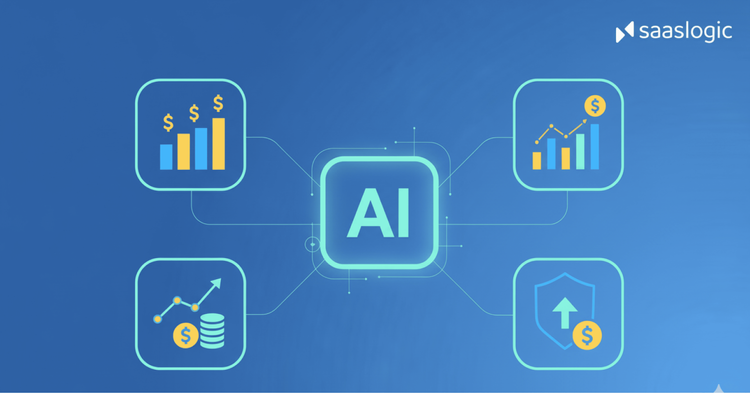
AI-native means the software whose core design, data model, and UX assume continuous ML/automation as a first-class capability and not an add-on.
Key features include:
1. Data-First Architecture
AI-native is built to ingest high-velocity event streams such as usage, product telemetry, & support interactions and keep models updated in real time.
2. Embedded Automation Loops
They are not just dashboards, but closed-loop actions (price adjustments, upgrade nudges, and billing corrections) triggered by model outputs.
3. Explainable, Modular Models
Predictions and recommendations can be traced to data signals. Thus, the revenue teams trust and act on them.
4. Billing and Metering Components
It provides native support for usage-based events, rating, mediation, and reconciliation. This makes the revenue flows accurate and auditable.
It is different from old “bolt-on AI,” where a company adds the prediction feature to their software, but the essential data systems and automation are missing. AI-native design makes tools easier to integrate and faster to use and it also avoids endless pilot testing.
The ROI Engines Behind AI-Native Tools
Below are the key quantifiable ways AI-native tools produce ROI for subscription and sales-focused businesses.
1. Driving revenue growth with improved pricing and usage models
AI that analyzes how customers use products and their willingness to pay can help create flexible pricing models that charge more to frequent users while making it easier for new customers to sign up. AI-powered usage-based billing improves accuracy and helps businesses grow quickly. This improves revenue without increasing the sales effort. Moreover, vendors implementing usage-based models have reported faster deal cycles and more built-in expansion opportunities.
Measurable metrics: ARR expansion rate, average contract value (ACV) growth from upsells, and deal cycle time reduction.
2. Lower operational cost via billing automation and error reduction
Billing mistakes and manual work cost companies a lot of money. AI-native billing systems detect anomalies, resolve routine problems automatically, and alert only for the real issues. This lessens billing problems and support workload, lowering the cost to serve and improving cash collection.
Measurable metrics: Reduction in days of sales outstanding, fewer billing disputes per month, and FTEs removed from reconciliation tasks.
3. Churn reduction through predictive retention and timely interventions
Predictive churn models that continuously learn from product telemetry, support tickets, and engagement signals help customer success teams to intervene before renewals approach. When models are integrated into automation loops, they can trigger personalized offers, in-app prompts, or risk-tiered playbooks - all of which have been shown to reduce churn in pilot and product deployments. Businesses implementing GenAI and predictive analytics in customer-facing processes observe enhancements in retention and a decrease in voluntary churn.
Measurable metrics: Reduction in churn rate, increased renewal rate, and improvement in Net Revenue Retention (NRR).
4. Better sales productivity through insight-driven prioritization
AI scores identify accounts that are likely to grow or at risk of churn, letting reps focus on the most promising tasks. When those scores are built into CRM workflows and paired with sales playbooks, close rates and rep productivity rise. In large enterprises, smarter routing and prioritization can meaningfully impact pipeline conversion.
Measurable metrics: Win-rate improvement, sales cycle shortening, and quota attainment improvements.
5. Faster product-led expansion enabled by event-driven recommendations
When the product itself can identify moments of value and automate upgrade prompts (in-app offers, frictionless checkout, or metered thresholds), expansion becomes part of the UX instead of a separate sales motion. AI-driven product prompts that catch micro-moments of value create a scalable expansion channel that directly contributes to ARR. This is mainly useful for usage-based and metered offerings.
Measurable metrics: % of expansion via product-led motion and conversion of in-app prompts to paid usage.
How to Implement AI Insights in Everyday Operations
When it comes to ROI, the hardest part of realization is not model accuracy; it’s operationalization. AI-native vendors succeed by bringing three important things together:
- Clean, real-time telemetry ingestion: Uninterrupted streams of product and billing events so that models reflect current behavior.
- Actionable outputs with human-in-the-loop controls: Model recommendations accompanied by confidence scores, causal drivers, and easy rollback.
- Closed-loop automation: Safe automations (billing corrections, offer issuance, & in-app nudges) that can be monitored and tuned.
Start small with high-impact, low-risk automations (invoice anomaly detection, automated mid-cycle upgrades for heavy users, renewal-risk alerts), and implement impact carefully.
A Straightforward Approach to Measuring ROI
A simple ROI system helps avoid confusion and keeps product, finance, and sales working toward the same goals. Track these:
- Direct revenue improvement: Incremental ARR attributable to AI actions (upsells, expansions, and higher ACV).
- Retention improvements: Reduction in churn and corresponding NRR lift.
- Operational savings: Labor hours reduced in billing and CS, lower DSO, and fewer disputes.
- Deal efficiency: Change in average sales cycle time and conversion rates.
- Compliance & leakage: Reduction in billing leakage or revenue recognition errors.
Why Subscription Management Is a Prime Use Case
Subscription businesses have huge databases (usage, entitlements, invoices, and renewals) and direct economic levers (pricing tiers, add-ons, and metered charges). This makes them perfect for AI-native approaches.
- Billing accuracy directly affects revenue recognition: Fixing billing problems leads to instant gains in the bottom line.
- Usage-based pricing works best when companies can track usage accurately and package their products flexibly: AI allows near real-time pricing nudges and anomaly detection.
- Retention is mission-critical: Small improvements in churn compound quickly for subscription toplines.
Final Thoughts
While the initial excitement surrounding AI centered on creating impressive models, the real ROI materializes when these models transform into practical and usable products. AI-native tools built mainly for subscription management and sales workflows with real data, transparent logic, and automated processes are the ones that convert AI into actual business results.
Improving billing accuracy, capturing usage revenue, and strengthening retention are the key improvements for subscription businesses. When these areas are tracked and optimized properly, the results multiply. Less churn means higher customer value, proper metering reduces lost revenue, and automated expansion lowers sales costs.
If your subscription team wants everything (usage rating, billing, automation, mediation, and retention tools) in one place, then Saaslogic is the best choice for you. Its built-in billing engine, usage tracking, and automation help your teams understand how customers use the product and convert those insights into recurring revenue.
G Rejitha
Senior Technical Content Writer
G Rejitha is a Senior Technical Content Writer with over 11 years of experience creating clear, engaging, and insight-driven content for the tech industry. With a strong focus on SaaS, AI, cloud, and digital transformation. Rejitha specializes in turning complex technical concepts into easy-to-understand narratives that help businesses connect with their audience. Her work expertise includes SEO-driven web contents, blogs, whitepapers, case studies, product documentation, newsletters, and more. Rejitha delivers content that supports brand credibility, drives engagement, and simplifies technology for decision-makers, product teams, and customers alike.
Related Topics
- Why SaaS Resellers Are Your Secret Growth EngineTue May 06 2025
- Winning Subscription Business Models in Today’s Market Thu Oct 03 2024
- Taking On Industry Giants, Saaslogic Launches New Subscription Billing Platform On Product HuntWed Jun 19 2024
- SaaS Oligopoly And How To Plan Your GameWed Jun 19 2024
- Starting Your Own Subscription Box BusinessWed Jun 19 2024
Categories
- Churn Reduction and Customer Retention
- Pricing Strategies and Revenue Models
- Billing, Payments and Invoicing
- Customization and Enterprise Use Cases
- Growth Scale and Business Strategy
- Subscription Management and Optimization
- Technology and Integrations
- Startups and Marketing
- Trends and Thought Leadership
- SaaS Accounting & Compliance
- Revenue automation
Frequently Asked Questions
AI-native platforms are developed with machine learning & automation at their core. This enables real-time actions such as billing, retention, and pricing, which directly boost revenue and reduce expenses. As a result, ROI is tracked in dollars, not just dashboards.